









Comparison of 5 Inch vs 6 Inch Gutters: How to Pick the Right Size for Your Roof
“I’m thinking about getting new gutters, but I’m not sure about the size—should I get 5 or 6 inches?” That’s one of the top concerns when it comes to gutter replacement. The choice of gutter width determines how much roof runoff can flow before the gutter overflows, gets soaked to the fascia, and splashes against the foundation.
Here’s the short answer: 5 inch gutters are commonly applicable for standard residential roofs, while 6 inch ones are usually needed for larger roofs, more inclined roofs, bigger drainage areas, or areas with heavier precipitation. However, that depends on several factors, and just choosing the wider option isn’t the solution.
Read further to learn more about how the comparison between 5 inch vs 6 inch gutters looks, which aspects determine the right gutter size, and when it’s better to seek help from professionals.

5 Inch vs 6 Inch Gutters: What's the Difference?
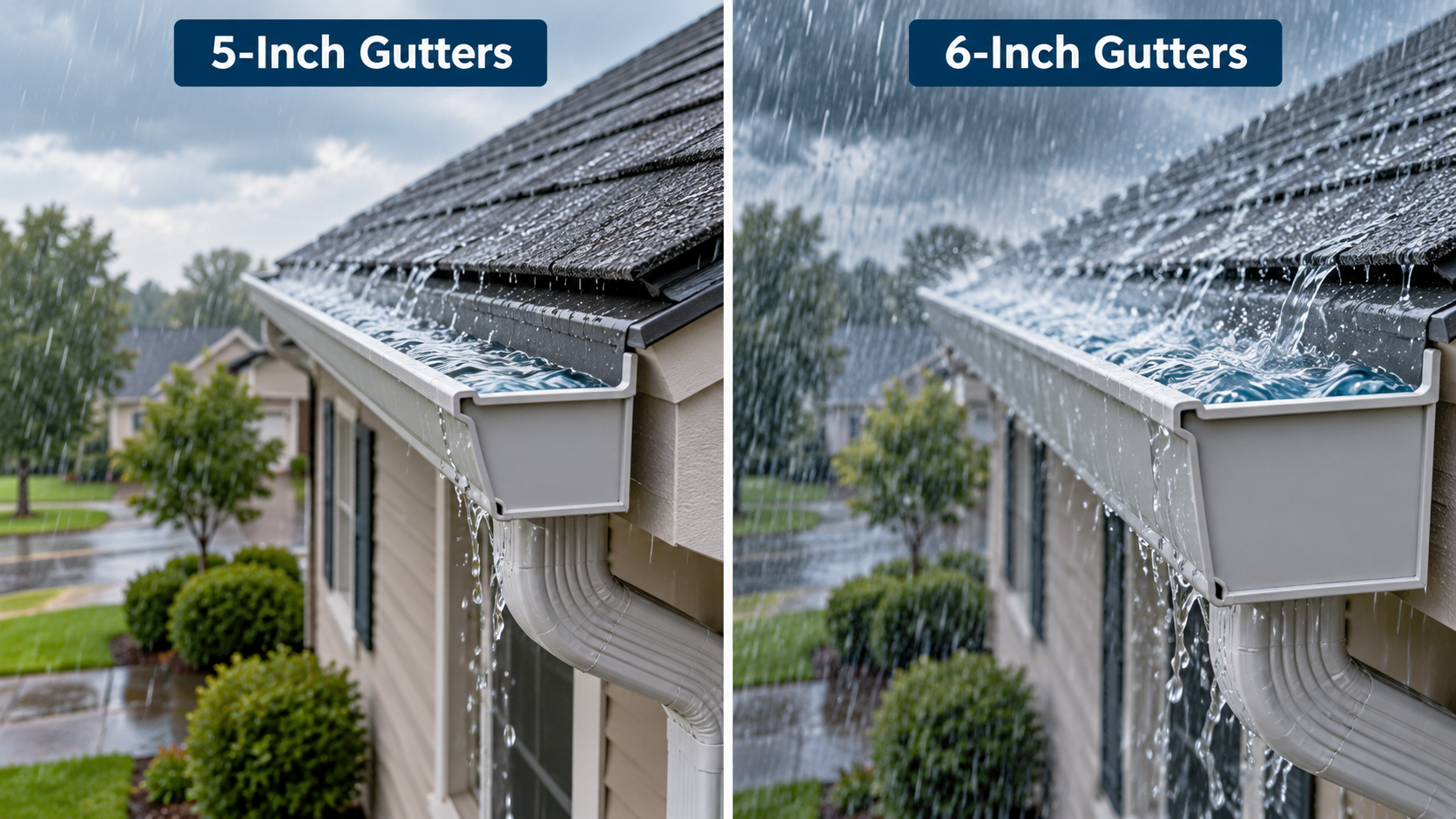
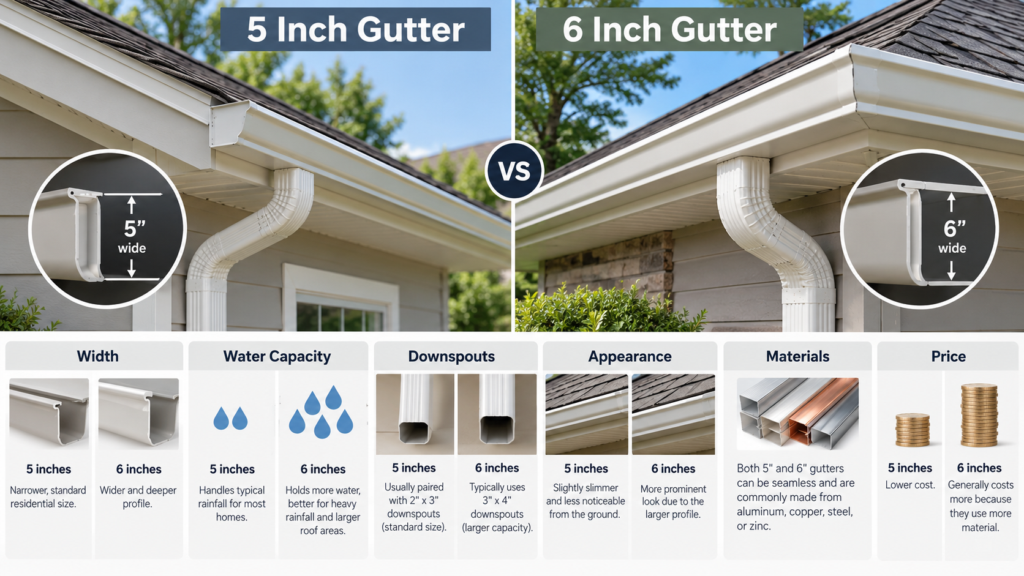
Well, obviously, the main difference lies in the width: 5-inch gutter has an opening of approximately 5 inches, while 6-inch one has an opening of roughly 6 inches. As a consequence, a 6-inch gutter is able to hold more water.
However, capacity isn’t the only difference between 5 and 6-inch gutters:
- Downspouts: Usually, larger gutters go with the larger downspouts, so that the capacity of the whole system remains the same;
- Appearance: 6-inch gutter is more noticeable at the roofline, while 5-inch is rather slim and unobtrusive;
- Materials and fasteners: both sizes can be made of common materials and are usually installed as seamless gutters;
- Price: normally, a larger gutter requires more material, however, the exact difference depends on your roof and materials, so confirm that in the written quote.
5-inch Gutters: When They Work Best
5-inch gutters are one of the most common options for installing on residential homes with standard roofs and standard drainage demands.
Advantages
- Lower profile
- May have smaller capacity requirements
- Typically cost less than the larger ones
Limitations
- May not be able to accommodate larger roof areas with more drainage
- Cannot accommodate steep roof, valleys or excessive precipitation
In what cases 5-inch gutters will be enough for your roof: If your roof has a moderate drainage area, a typical pitch, standard roofline, and proper placement of downspouts, the 5-inch gutter system may suit you.
6-inch Gutters: Why They Can Be Needed
6-inch gutters are able to handle more roof runoff, so they’re usually installed when there’s a need to move a bigger volume of water.
Situation where 6-inch gutters can be beneficial:
- Large drainage area: more roof means more water flow;
- Steep roof: water drains faster from the roof and may rush to the gutter;
- Concentrated flow: valleys, dormers, roof-to-wall intersections concentrate water into one place;
- Excessive precipitation: the larger gutter gives water more space instead of letting it overflow.
Limitations: 6-inch gutters are noticeable, usually cost more in material and may require larger downspouts and fittings. Still, the large gutter won’t help if it’s improperly pitched, hung with poor hangers, or has improper downspout spacing.
When 6-inch gutters are needed: when the roof, pitch, and precipitation pattern put high demands on the gutter system, or when a clean and properly installed 5-inch system keeps overflowing.
5 Inch vs 6 Inch Gutters: Short Comparison
Feature | 5-inch Gutters | 6-inch Gutters |
Width | Approximately 5 inches across | Approximately 6 inches across |
Water capacity | Okay for many residential homes | More capacity; able to move more water at once |
Typical use | Standard roof and moderate drainage | For larger homes and more complex roofs, greater runoff |
Roof size | Small to medium-sized drainage area | Larger drainage area |
Roof pitch | From low to moderate | From moderate to steep |
Heavy precipitation | Able to cope with proper drainage and downspouts | More capacity in case of heavy rain |
Price | Typically cheaper in material; confirm in the quote | Typically more expensive in material; confirm in the quote |
Appearance | Slimmer profile, lower | More noticeable |
Maintenance | Clogging may result in overflow earlier | More space for the clogs, but still requires regular cleaning |
This comparison shows general trends, not absolute rules: good design of 5-inch gutter may outperform a poorly designed 6-inch one.
What Size Gutters Does Your Roof Actually Need?
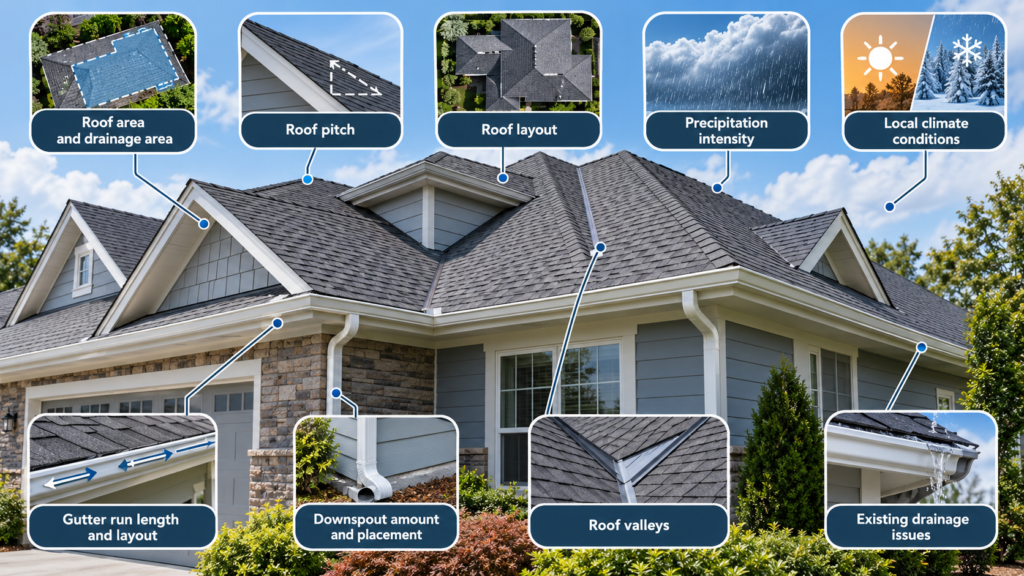
The size of the gutter should be determined depending on how much water flows from your roof to the gutter system. Choosing the gutter size isn’t about picking the wider size only. The key aspects to consider are:
- Roof area and drainage area. More roof surface means more drainage demand;
- Roof pitch. Higher the roof is, faster and stronger water flows from it;
- Roof layout. Several levels, dormers, additions direct water to certain parts of the gutter;
- Precipitation intensity. Intensity of the precipitation tests gutter more than the annual amount of the rain. Short and heavy showers are the biggest test of the gutter system;
- Length of the gutter run and layout. Longer gutter run with one downspout is more likely to overflow than short one;
- Amount and placement of the downspouts. More outlets and their proper placement shorten distance water has to travel;
- Roof valleys. Valley collects water from two planes of the roof in one concentrated flow;
- Local climate conditions. Weather patterns of the area play an important role as we’ll discuss later in the article;
- Existing drainage issues. Water overflows, pooling and staining are useful for determining drainage demand.
Why the Local Climate Makes a Difference in Northern New Jersey
The same project can add value or create new problems depending on how it’s done:
- Workmanship: Flashing, sealing, and fastening determine whether work lasts.
- Proper materials: Products should suit the application.
- Local conditions: NJ weather, codes, and permits shape how work is done.
- Safety: Roof and chimney work involves heights and structure.
- Long-term durability: Correct installation helps materials reach their service life.
- Buyer confidence: Permits, warranties, and documentation reassure buyers and inspectors.
R&G Home Services (R&G Roofing, Carpentry & Siding) is based in the City of Orange and has served Essex County homeowners for more than 25 years. The company is a GAF Master Elite® certified roofing contractor, and its own team handles its roofing work rather than subcontracting it.
Because R&G handles roofing, siding, windows, gutters, baths, skylights, chimneys, and carpentry, overlapping projects can be planned together. You can read more about R&G and their process.
Residential buildings in Essex County and other parts of Northern New Jersey can face summer thunderstorms, nor’easters, remnant tropical systems, and freeze-thaw winters. These can provide intensive precipitation that’s the reason why gutter overflows happen most often. There are lots of houses in the region with old roofs, valleys and additional roof levels that concentrate water flow.
To have an idea about precipitation intensity in your area, NOAA provides precipitation frequency data for the locations across US. However, that’s a reference point and can’t replace professional roof assessment.
When to Choose 5-inch Gutters
5-inch gutters are a good choice in the following cases:
- You have a standard-size construction with the standard roofline;
- Your roof has low to moderate pitch;
- Roof sections are modest, without large valleys flowing into one place;
- You have the properly sized and spaced downspouts;
- The existing gutter system copes with the majority of precipitation and you need to replace aged or damaged sections.
Example: a modest two-story residential building with a gable roof and downspout at each end of the gutter run is typically a proper candidate for the 5-inch gutter system.
When You Need 6-inch Gutters
You need to consider 6-inch gutters if:
- The home has large roof or long, continuous roof planes;
- The roof is steep;
- Valleys, dormers or roof-to-wall intersections concentrate water flow;
- There is a heavy precipitation testing the gutter;
- A clean and properly installed 5-inch gutter is still overflowing.
Example: a larger two-story residential building with a steep roof and valley dumping water to one gutter section. Even with the proper maintenance, 5-inch gutter can’t cope with heavy precipitation in this case and 6-inch gutter with proper downspout might be a good choice.
Is 6-inch Gutter System Worth Additional Costs?
It depends on your roof’s drainage demands. For some roofs, 6-inch gutters can be excess.
- Increased capacity: if your roof is sending large amounts of water to the gutter system, increased capacity prevents overflow and related damage.
- Installation: 6-inch gutters usually require appropriate hangers, outlets, and downspouts affecting the overall project.
- Materials: materials and their thickness are crucial for durability as much as the width.
- Long term savings: preventing frequent overflows protects fascia, siding, and foundation drainage areas.
- Roof specifics: for modest and simple roof, additional width adds almost nothing.
Prices depend on the materials, size of the building and roof layout. Compare quotes for both sizes.
Can 5-inch Gutters Handle Heavy Rain?
Yes, in most cases. A properly installed 5-inch gutter with appropriate slope, number of downspouts and regular cleaning can withstand heavy rain for many residential buildings.
However, in some cases, 5-inch gutters are unable to manage heavy rain. To understand if it happens to your roof depends on the drainage area, roof pitch, valleys and dormers concentration, number and size of downspouts, and if the gutters are clean and pitched properly. In case of 5-inch system’s overflows despite proper installation, you need to re-assess the layout, downspouts, and possibly size.
Do You Need Larger Downspouts with 6-inch Gutters?
Usually, yes. A gutter can’t move more water than its downspouts can discharge it. If large gutter is connected to small downspout, downspout becomes a bottleneck and the gutter can overflow and spill water.
In typical residential practice, 5-inch gutters are often paired with smaller downspouts and 6-inch gutters with larger ones. The right combination depends on your roof area and layout, so you need to confirm that during the assessment. Placement is also important: more outlets positioned in the concentrated places reduce the load on the system.
Common Signs Your Gutters May Be Too Small
- Gutters overflowing during moderate or heavy precipitation
- Water spilling over the front edge
- Pooling of water near the foundation
- Water stains on siding, soffit, or fascia
- Sagging gutter sections
- Excessive accumulation of debris
- Erosion or washed-out soil around downspouts
- Recurrent drainage problems after the precipitation
Gutter overflows don’t necessarily mean that your gutters are too small. There are more common reasons such as clogs, improper slope, improperly sized or blocked downspouts, improper hangers, or installation defects. First, rule them out. Gutter cleaning or gutter repairs may solve the problem without the need to increase the gutter size.
5 Inch vs 6 Inch Gutters: Which One Should You Choose?
You should choose 5-inch gutters if:
- You have a typical residential roof
- Drainage demand is moderate
- Appropriate roof area per gutter run
- Properly sized and positioned downspouts
You need to consider 6-inch gutters if:
- Your roof area is large or the roof is steep;
- Large sections drain into the same gutter run;
- Valleys concentrate water;
- Heavy precipitation increases the flow;
- An existing 5-inch gutter system is frequently overflowing despite the fact that it’s properly installed and maintained
These are general recommendations and can’t replace professional roof assessment
Why Professional Assessment Is Important
Choosing the gutters by appearance or price only is a common mistake. The professional assessment takes into account all aspects of the system: roof area, pitch, valleys, downspouts quantity and size, slope, condition of the fascia and where water flows after leaving the gutter.
It’s very important because inappropriate or poorly designed system leads to overflows, staining, fascia damage, and pooling near the foundation. A professional will also be able to tell whether a change of the size is really required or there is another way to solve the problem. For general roofing and exterior best practices, the National Roofing Contractors Association (NRCA) is a valuable source of knowledge.
Climbing ladders and working at the roof edge is dangerous, so it’s better to leave that work to professionals.
Gutter Services of R&G Home Services
R&G Roofing, Carpentry & Siding is a professional roofing company with more than 25 years of experience in Orange, New Jersey. R&G is a GAF Master Elite certified roofer serving homeowners all over Essex County and other regions of Northern New Jersey.
Gutters go along with the roof and it’s easier to install both if there’s one team that knows all the details of them. The company’s gutter services include:
- Gutter installation and replacement
- Gutter repairs and rain gutter repair
- Gutter cleaning
- Gutter guards
- Downspouts and drainage solutions
- Ice dam removal
The company also provides roof repairs, roof replacement, siding, window installation, carpentry, skylights, and chimney services. In case you’re not sure about the size of your current gutters, you can estimate your gutter needs and discuss the options.
Conclusion: 5 inch or 6 inch gutters?
There is no universal size of the gutter that is good for every roof. The size depends on roof area, pitch, drainage layout, precipitation intensity, downspouts and installation quality.
In 5 inch vs 6 inch gutters comparison, 5-inch gutter is a standard and reasonable choice for many residential roofs, while 6-inch gutter is a great choice if your roof sends more water than small gutter can accommodate. The main thing is that the gutter, slope and downspouts should work together.
For the clear recommendation about your home, please contact R&G Home Services at (973) 324-9461 or use contact page to get an assessment or quote.
Are 6-inch gutters better than 5-inch gutters?
Not automatically. 6-inch gutters can carry more water, which is helpful for larger, steep or complex roofs, but they are not necessarily required for every roof. A properly installed 5-inch gutter with appropriate slope and downspouts is enough for many standard roofs. It depends on the drainage demands of your roof.
What size gutters does a typical house need?
Most typical residential buildings use 5-inch gutters, while 6-inch gutters are common for larger or more complex roofs. However, the right size of the gutter depends on the area, pitch, precipitation intensity, valleys and downspout layout. A professional will assess your roof and make a recommendation about the appropriate size.
When to use 6-inch gutters?
New siding can improve property value by refreshing curb appeal and protecting the home from moisture. Damaged or faded siding often makes a house look neglected, which affects first impressions. Results depend on material quality, installation, color choice, and how the home compares with others in the neighborhood.
Can 5-inch gutters handle heavy rain?
Yes, in most cases, if the roof area is proper and the system is properly installed and maintained. Heavy rain becomes the problem when large roof areas, steep pitches or valleys send more water than the gutter and downspouts can drain. If a clean 5-inch gutter system overflows, you may need to reconsider the gutter size and layout.
Does the roof pitch influence the gutter size?
Yes, it does. The steep roof sends water faster and with more force, which can carry water past the smaller gutter’s edge. The low-pitch roof sends water slowly. But roof pitch is only one of many factors that affect the size of the gutter: area, valleys, precipitation intensity and downspouts.
Are 6-inch gutters more expensive than 5-inch gutters?
Typically they involve more material and larger downspouts and therefore more expensive. The exact difference depends on materials, size of the building and roof layout, so there is no single price for every project. Compare written quotes for both sizes to see the difference.
How do I know if my gutters are too small?
You need to look for the following signs: gutters overflowing during precipitation, water spilling over the front edge, pooling of water near the foundation, staining of the siding or fascia, sagging and erosion around downspouts. However, these symptoms can appear due to clogs, improper slope, blocked downspouts or installation defects, so you need to consult a professional before making conclusion about the size.
Can the gutters replacement prevent water damage?
Yes, it can help. Appropriately sized and properly pitched gutters with sufficient amount of downspouts direct water away from roof edge, siding and foundation. However, replacement itself isn’t a guarantee of the absence of problems. The installation quality, downspouts placement and maintenance will also affect the ability of the gutter system to protect your house.
